REST API Overview
|
Topics: |
Representational state transfer (REST) is a software architectural style that defines a set of constraints to be used for creating Web services. Web services that conform to the REST architectural style, called RESTful Web services, provide interoperability between computer systems on the Internet. RESTful Web services allow the requesting systems to access and manipulate textual representations of Web resources by using a uniform and predefined set of stateless operations.
iWay Trading Partner Manager (TPM) exposes the REST API, which can be used to easily create custom web pages or display data in existing web pages. The REST API helps to perform the most common TPM operations available through the TPM user interface. That means the same transaction, pooling, and caching are available and can be using in conjunction with the TPM user interface. This appendix covers the usage of the iWay TPM REST API.
Accessing the TPM Console REST API
iWay TPM includes a wide selection of REST API calls that can be accessed through the Swagger UI.
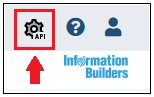
After you have logged in to iWay TPM, click the TPM Console REST API icon, which is located in the upper-right corner of the iWay TPM user interface, as shown in the following image.
The TPM Console REST API opens in a new browser tab, as shown in the following image.
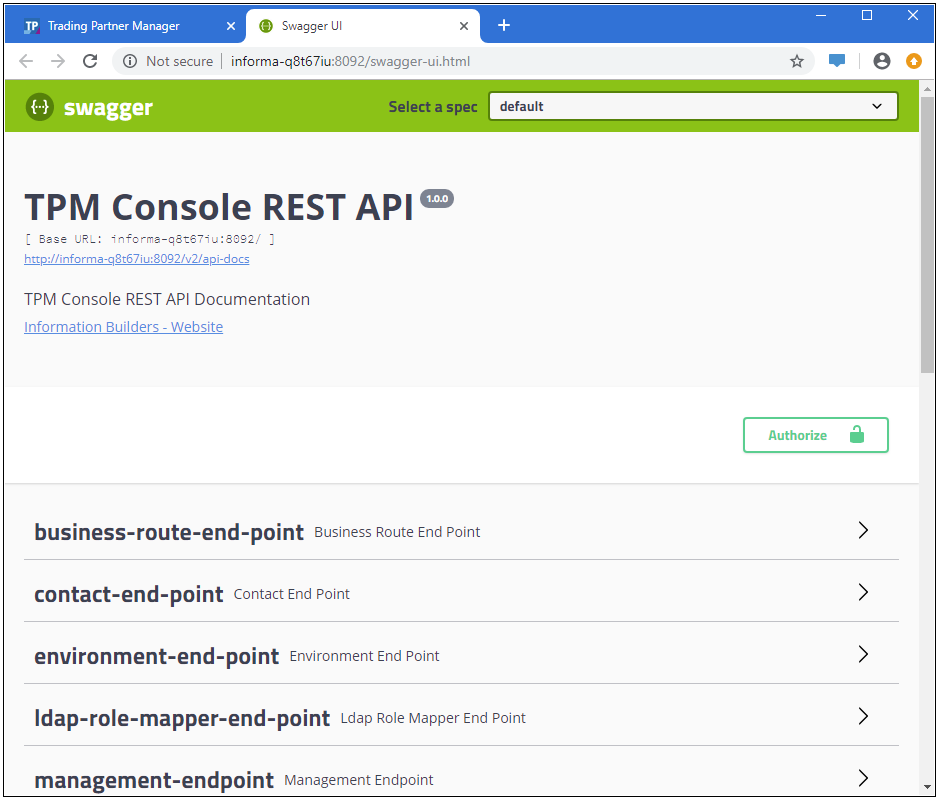
Swagger offers the ability for each REST API call to be test run from this console and also displays sample output.

Available TPM REST API Calls
You can access and test the following TPM REST API calls through the Swagger UI:
- Business Route End Point (business-route-end-point)
- Contact End Point (contact-end-point)
- Environment End Point (environment-end-point)
- Ldap Role Mapper End Point (ldap-role-mapper-end-point)
- Management Endpoint (management-endpoint)
- Message Format End Point (message-format-end-point)
- Message Type End Point (message-type-end-point)
- Meta Data End Point (meta-data-end-point)
- Partner End Point (partner-end-point)
- Partner System End Point (partner-system-end-point)
- Partner System Messages End Point (partner-system-messages-end-point)
- Role End Point (role-end-point)
- Route Code Sub End Point (route-code-sub-end-point)
- Route Contacts End Point (route-contacts-end-point)
- Standard Code Substitution End Point (standard-code-substitution-end-point)
- Standard End Point (standard-end-point)
- System End Point (system-end-point)
- Tpm Data Type End Point (tpm-data-type-end-point)
- Tpm Domain Sub Type End Point (tpm-domain-sub-type-end-point)
- User End Point (user-end-point)